Sunday, April 30, 2006

Top 10 Comics since 1979
7. Animal Man #5: The Coyote Gospel

DC Comics
1989
Writer: Grant Morrison
Artists: Chas Troug,
Doug Hazelwood


Grant Morrison makes his first of four appearances on the countdown here. Animal Man was a mostly forgotten Silver Age character when Grant got his big stateside break on his revamp. The basics: Buddy Baker, by virtue of being to close to an exploding spaceship is given the ability to take on the natural abilities of any animal he comes into contact with (instead of, say, getting third degree burns or losing a limb). If he's around a bat he has radar, around a bird he can fly, around a...you get the idea.
It's Silver Age cornball at its height. But Grant made the correct decision, very early on in the run, of focusing more on Buddy himself, and his family, than on what fantastic abilities Buddy possessed. Paying the bills was just as important to the Bakers as saving the Universe.
That said, The Coyote Gospel has next to nothing to do with Buddy Baker, his family, or his abilities. Instead, it's Grant Morrison's howling, bizarre introduction to the DCU, a place he would always do his best work.

We begin with roadkill on the desert highway. Immediately we're given an image of nature under man's control, of destruction and violence.
But we're also shown the caring side of humanity, as we're privy to the conversation between a trucker and a runaway he's picked up along his route. He's full of stern, parental concern:
"I don't think you know how lucky you are I came along. Hitching In the desert is suicide, man."
"Yeah, well, the last guy kicked me out because I wouldn't, like, y'know..."
"Yeah, I know."
The trucker has a past in L.A., where young Carrie is heading. He offers her advice, turn back and go home. He knows the streets she'll be on soon. He also knows the road out:They drive on, singing along to the radio, their worries momentarily forgotten. Then, a shadow comes into the middle of the road, they slam into it head on. The girl is terrified, the trucker just stares ahead grimly. "Forget it, just don't look back."
But we don't follow the girl and the trucker down the road, we stay with their fresh kill.
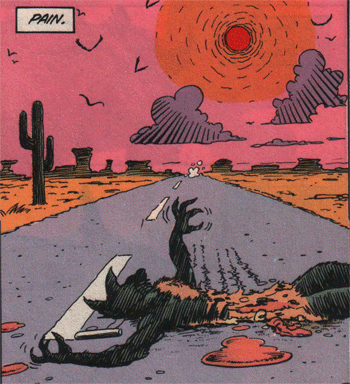
The creature writhes in the sun, his organs and bones reforming. From the narration: "A newly activated nervous system is suddenly jammed with frantic signals, like an overworked switchboard. The creature shudders, weeping. Its pelvic girdle fuses along hairline sutures, to cradle rapidly healing organs..."
Grant's words give the creature vivid, disgusting life. He rises to his feet and, like any good movie monster, stares at his audience.
From the very beginning, we see there's something different about this beast. Something...strange, goofy, ok I'll say it: Looney.
Our friend Crafty is none other than Wile E. Coyote, Christ figure.

We rejoin the trucker, but he's much different. The silver cross is gone, and his head is shaved. His 'friend' Billy has died in an accident, his mother is dead of cancer, and he finds out that Carrie has been killed in a drug raid, after living as a prostitute in L.A.
He has lost the gentle, loving look in his eyes. He's a desperate, scared man. He has come to blame his loss on the devil. And the devil, in his eyes, is Crafty. Only by destroying the beast can he soothe his heart, and deal with his loss.
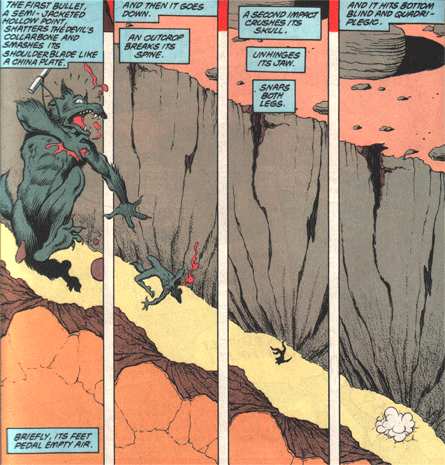
He finds Crafty and blows him off a high desert cliff. Any fan of Chuck Jones knows where this is heading:Troug and Hazelwood are not amazing artists, their style was pretty much par for the course in 1980's comics: just good enough to not be distractingly bad. But they do a wonderful job of recreating typical cartoon moments like the ones above, and I love this reaction shot, which is as close to eyes popping right out of Crafty's head as his new, more dynamic anatomy will allow.
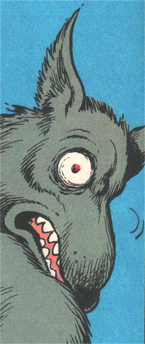
But to the trucker he is Satan incarnate. That's the only thing his Christian background will allow him to see Crafty, and nature in general: as tools of the devil.This is not to say that the book is an attack on Christianity. The trucker is every bit as pathetic and pained as the coyote. But his single minded obsession with defeating evil blinds him to the fact that he shares Crafty's pain.

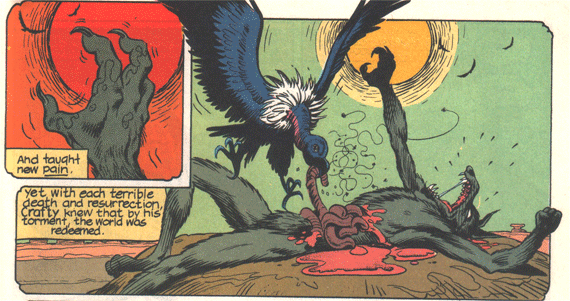
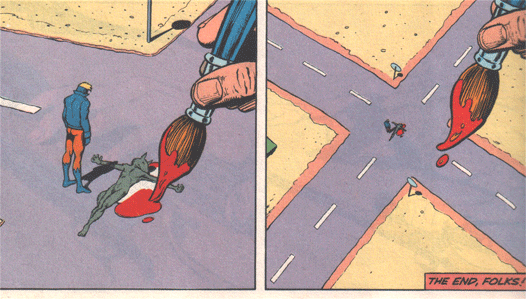
Crafty seeks out Buddy, and it is Buddy that he gives his grand message of faith to: The Gospel According to Crafty.Crafty comes from a world where constant, meaningless violence is accepted as the norm and never questioned. Where cartoon critters maim and explode each other endlessly for the entertainment of a cruel, vengeful God. Crafty goes up into the presence of God, an animator on a golden throne with blood red paint dripping from it.Crafty is sent 'into the dark hell of the second reality" to bear "the suffering of the world", on the condition that while he does, God will make peace between the beasts of his world. Crafty is not so much a Christ as a Prometheus, defying the will of God to serve humanity, to "overthrow the tyrant God, and build a better world."
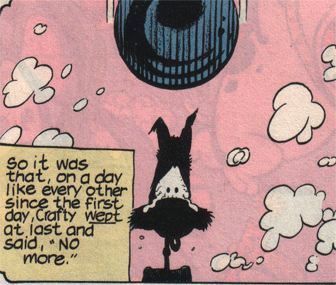
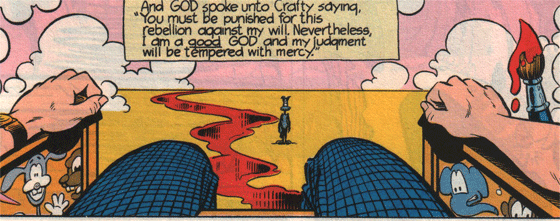
But even Animal Man cannot help Crafty.And the trucker, slave to a vengeful God just as Crafty is, makes his last effort, with a silver bullet made from the cross he'd worn (a denial of Christ, of the resurrection). The bullet finds its mark, and the trucker collapses, mission accomplished.Will he ever get up again? Given that he has nothing left to live for, it hardly seems to matter.
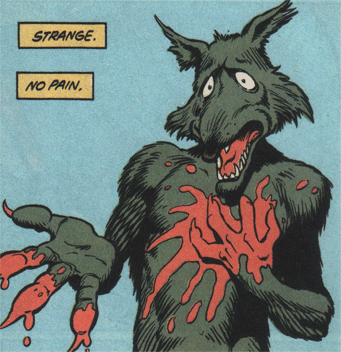
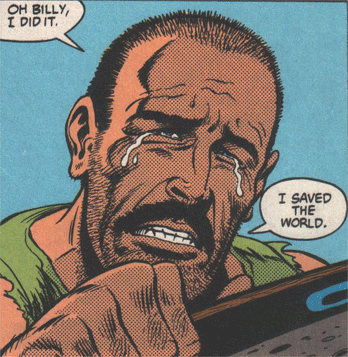
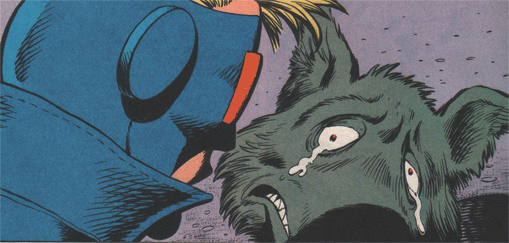
There's no way Buddy can know the larger importance of what he's witnessing, but he stays with Crafty as he dies, out of basic, human compassion.You don't need a thought bubble to read "My God, my God, why have you forsaken me" in those eyes.
But, as he bleeds his last, Crafty is ultimately given the peace that he sought. His God delivers to him, at last, a dignified and merciful death.
Thursday, April 27, 2006

New Comic Reviews:
Astonishing X-Men, X-Factor, Frankenstein

ASTONISHING X-MEN #14

I'm not a giant Joss Whedon fan: I liked Buffy, but I hated Serenity.
But what Whedon's doing for the X-Men I totally love.

I grew up reading X-Men, so they're characters that are ingrained in my psyche: Cyclops, Wolverine, Jean Grey, Storm, the whole lot of 'em. But when you look at the stands and see 17 X-books, and only a handful of them worth exploring, you realize that Marvel is stretching the concept way too thin.
What Whedon does that the other writers don't is take risks. Some, like the return of Colossus, are unforgettable; some, like the sentient Danger Room, are brilliant failures.
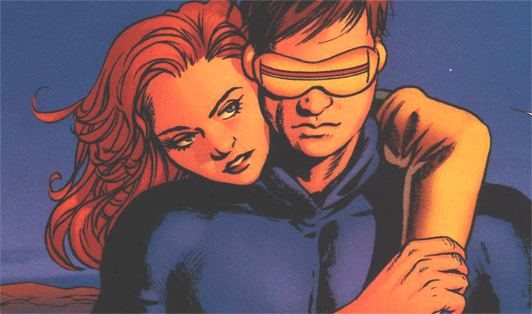
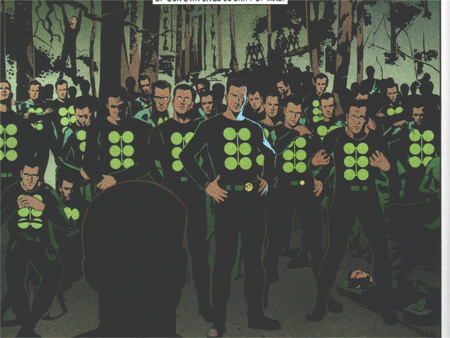
What I love about this issue is that it puts the spotlight, finally, on Scott Summers, aka Cyclops. Most writers never touch on Scott, except as a straight-laced foil to Wolverine. No run that I can remember focused on Scott himself, who he is inside and what drives his need for total control, of himself and mutants at large.
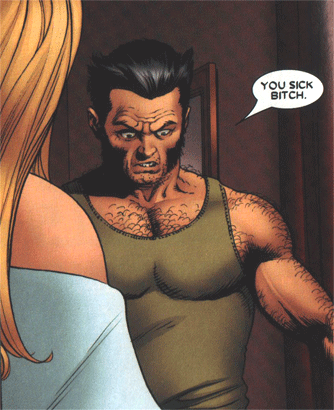
Whedon also does what should have been done a long, long time ago: making Emma the White Queen again. Emma Frost will never be anything but, well:That's not Wolverine, by the way, it's Emma toying with Scott's confidence. Emma is slipping back to her old ways, and she's doing it gradually, even though she's such a powerful psychic she could do whatever she wanted to Scott. She's molding him into the man she needs him to be to stand at her side when she flips.
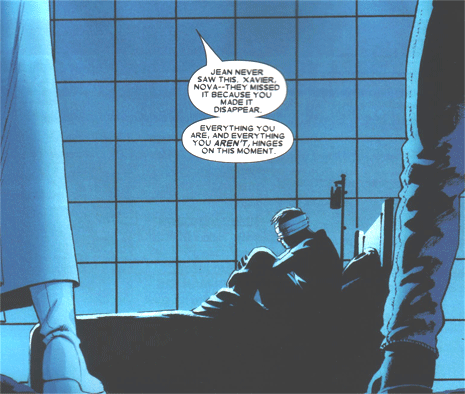
But, whether or not Scott's decision is an illusion, placed in his memories by Emma, it's a sad and moving moment. Also, I'm damn near giddy about the return of Cassandra Nova, the best thing Grant Morrison ever gave the Marvel Universe. She's pure malice in that panel, and Whedon should take full, evil advantage of her presence.
I continue to be floored by John Cassaday's art: he's a man among little boys over at Marvel, and I'm glad they give him the time he needs to be this wonderful. What I love the most is how ordinary he makes the X-Men look. These are not the straight-from-an-80's-fashion mag X-people of Jim Lee or even John Byrne: these are real people, and you grieve and laugh with them all the more because of it.
And, along the same line of thought, I really love his Jean Grey. She's so girl-next-door lovely, but haunted. Just like she should be. I hope this is setting up another return, because enough already: we need Phoenix back. This was a great, fun issue. Astonishing is back on the right track, this run looks amazing.

ASTONISHING X-MEN #14: A+


X-FACTOR #6

Meanwhile, over in the only other X-book you should be bothering to read, Syrin lies in bed recovering from her viscous beating two issues back, and her bondage-tinged ordeal last issue. While the X-Factor crew talks over each other about what to do, Rictor lashes out at Layla. "You come out of nowhere saying you 'know stuff'...You made sure I was at that gas station when that girl was in trouble...and that guy who was ready to kill me...winds up being taken out by you, because he just happens to be standing in the right place to be electrocuted?...Did you know Terry was going to be jumped, Layla? And if so, why didn't you do whatever it is you do to stop it?"
Finally we get to the heart of Layla Miller, who she is, where she came from, and how she 'knows' what she 'knows'. Ever since she first appeared in the big House of M event, she's been at once an irritant and a breath of fresh air. We learn here that Layla is essentially a ripple in space and time, a living embodiment of chaos theory. But beyond that, we like Layla immensely by the end of this one. Stripped of her adopted family she loses her know-it-all smirk and is subject to the same abuse that her mutant (and former mutant) brethren are. She becomes fragile and real.Denis Calero is surprisingly effective here. He does best at small, personal moments (he could never have made the splash page at the end of issue 1 hit as hard as Sook); there is some striking art in this book. There is also more of the amateurish, ugly postures and bizarre expressions of the last few issues.
I'll say this much about Denny Calero: he is not a great artist now, but in time he could be. I'm still not sure I want him on X-Factor, but I'm having trouble now picturing it without him.
X-FACTOR #6: A-


FRANKENSTEIN #4

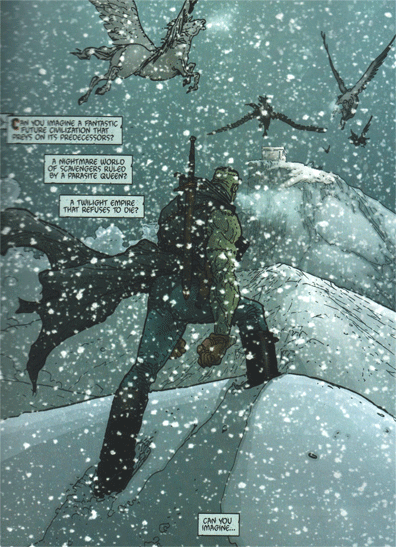
I've never tripped on mushrooms, but after reading this issue I think I may know what it's like. Frankenstein #4 genuinely threw me, but in a good way. It took me quite a few reads to pin this issue down, but once I did, it blew me away.Grant Morrison may have found his ideal collaborator in Doug Mahnke. There is something so specific about the worlds he can create visually that syncs pefectly with what Grant does. His worlds are fantastic, but they feel real, and immediate.

We open with our man Frankie trudging to battle with Neh-Buh-Luh, the Huntsman who we find is still pining away for Misty, Zatanna's sidekick and Snow White of this here tale.
"There was harmony, symmetry and beauty in her. I cannot forget. Like an insect writhing on a pin in the glare of the sun. I cannot forget her."
I love how much more elevated the speech and narration is in the Frankenstin minis than the other Seven Soldiers books, it adds to the out-of-time feel of the hero.

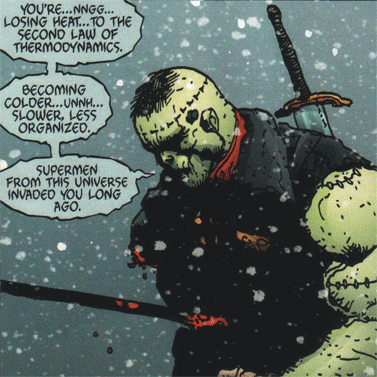
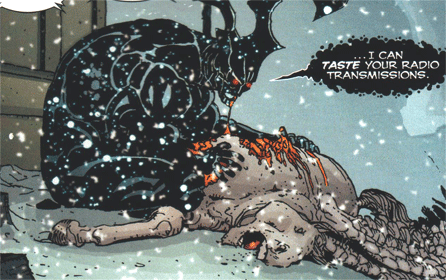
Neh-Buh-Luh is defeated, not so much by Frankenstein, but by an internal flaw, so says Frankie:Those supermen were the International Ultramarine Corps way back in JLA Classified. He is brought down by billions of years of internal decay. I'll miss the Nebula-Man, though. I hope, somehow he still makes an appearance in Seven Soldiers #1.
Frankie, with the help of S.H.A.D.E., tracks the Sheeda to Miracle Mesa, where this whole thing began, to Castle Revolving. Oh, and he's not alone:Justin, is that you?

From that point, we flash forward to one Billion years later.
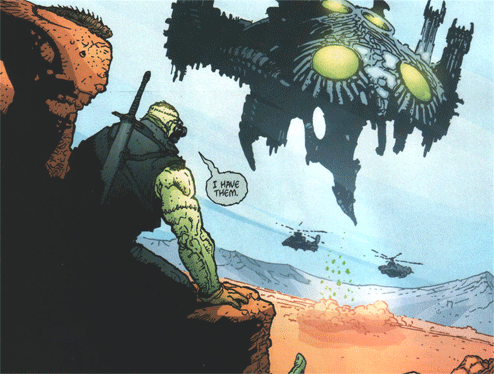
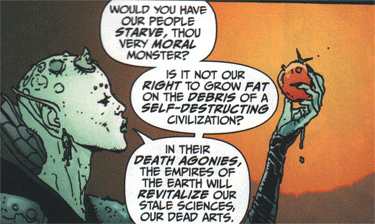
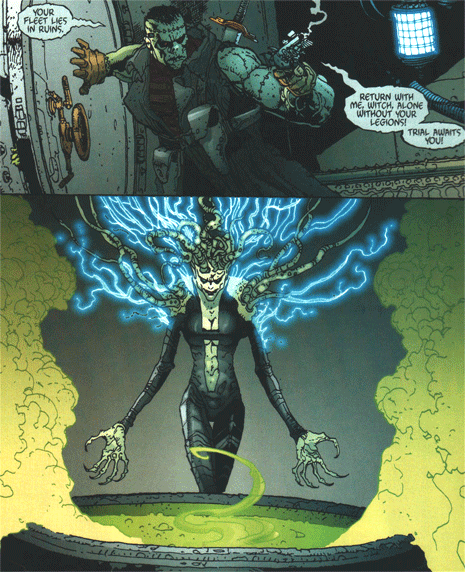
The Earth is being pulled into the sun, the Sheeda stand victorious. We are at the end of time. We are, at last, at Summer's End. We now know where the Sheeda come from: they are invaders from our own end, they are (as Gloriana tells Frankie, taunting him with the apple like the snake in Eden) human, the last end of evolutionary progress. The final stop in the survival of the fittest, and they travel back through time to feast on civilizations throughout history at will. Frankie, bless his undead heart, is unimpressed as ever. He brings down the bulk of the Sheeda fleet, and challenges Gloriana, taking her back to our time to face death and judgment. A thrilling end to a spectacular series. To be continued...

FRANKENSTEIN #4: A+

Monday, April 24, 2006

Top 10 Comics since 1979
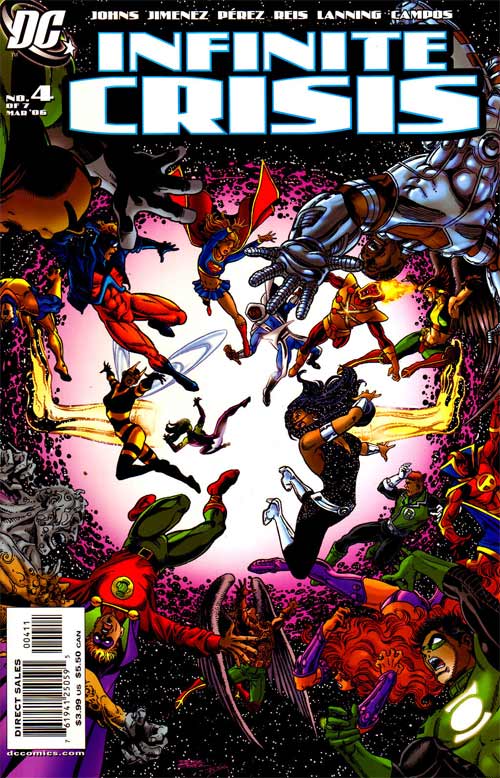
8. Infinite Crisis #4: Homecoming

DC Comics
March 2006
Writer: Geoff Johns
Pencils: Phil Jimenez, George Perez, Ivan Reis


What in the hell is this issue doing on my list, you ask? Well, let me put it this way: I'm pretty discriminating when it comes to film (or a snob as some wags might say); but until I die The Empire Strikes Back will be on my all-time Top Ten Films list. Sometimes, you just need a little action and excitement.
Or one hell of a good fight.

Infinite Crisis, as detailed elsewhere on this site, has been up and down. I read the first issue and enjoyed some of it (Bizarro's bloody dispatching of the Human Bomb, for instance; Batman's scathing line to Superman: "The last time you inspired anyone was when you were dead."); but the ending, bringing back the Crisis on Infinite Earths alternate universe crew seemed oddly handled. I was left cold by issue two, the Power Girl origin crap and the continuing drone of how rotten the current DCU was, and how beautiful it had been in the Golden Age (otherwise known as Earth-2).
But Issue 3 was a tremendous turnaround: Alex Luthor ad Superboy-Prime revealed as the masterminds behind the Crisis; Earth-2 Superman's offer to Batman; and Themiscrya Island fading into oblivion as Wonder Woman looks on.
Also, the art was gorgeous. Something about the look of the first two books just felt off,the inking in particular. All the Crisis books have been inked 'by committee' to get the product out faster, and the first books were ugly and rushed as a result.
But the penciling has been solid: Phil Jimenez has proven himself, on his days penciling the Invisibles, as one of the tightest artists in comics today. His style is clean and bold, making him a perfect choice for a big event like this. The messy look of the first issue especially caught me off guard, but by Issues 3 and 4, the inks were better and as a result, the action hit harder.

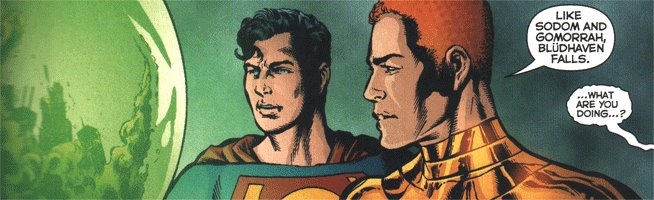
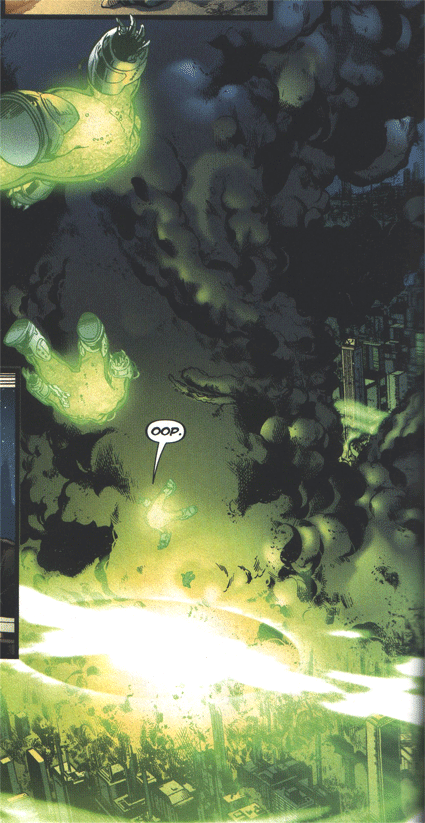
We open on Alex and Luthor overseeing the destruction of Bludhaven, in a great opening sequence featuring Chemo, the evil green giant of the DCU and a gorilla in a bandolier (sweet Christ I love comics in moments like these).
"Do you think Chemo understands what we're gonna do?"
"I do not think he cares."
Chemo himself has very little to say on the subject.The whole sequence reminds me of Hitchiker's Guide when the Sperm Whale is brought into existence by the Probability Drive, only to be splattered blubber bits seconds later ("Hey, what's this thing suddenly coming towards me very fast? Very very fast. So big and flat and round, it needs a big wide-sounding name like...ow...ound...round...ground! That's it! That's a good name-ground! I wonder if it will be friends with me?")

Anyway, millions of people are vaporized, and Alex and Superboy-Prime have a typically James Bond villain moment with Power Girl, locked into her place on their tower. They explain to her, now that she's locked into Anti-Monitor corpse powered phallic symbol, just how they've manipulated both the heroes and villains of the DCU. All they need is Alex Luthor sitting in a chair stroking a fluffy white cat.

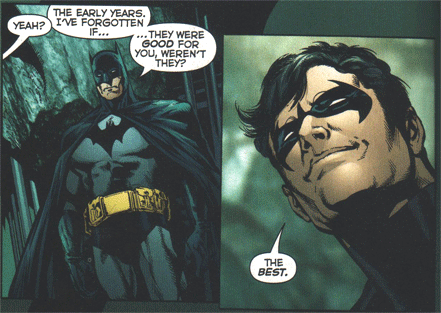
Geoff Johns is a fun writer, he has good ideas, but sometimes he gets cutesy, or maudlin. In this issue he strikes, most of the time, the right notes in his scenes. The focus of the emotion here is between Batman and Nightwing, Dick Grayson, former Robin. Bruce Wayne clearly views Dick with the stunned pride of a father realizing his son's grown into a decent and noble man and wondering: what did I possibly have to do with that?
Batman's raging self-doubt has become personified in Brother Eye, his superhero spy satellite, and here is a man who lived through the same trauma that Bruce did, who fought the same criminals, felt the same pain, joined the same cause.
But he is standing tall in the light while Batman cowers in the shadows.It's a nice moment, but a note that has not been maintained for the rest of the Crisis books. Dick Grayson made a choice to walk away from Batman, and become his own man, and take on another identity while still fighting crime. I had thought Infinite Crisis was going to make it clear just how hard that decision was, and just what kind of a man Dick was. But so far, it's fallen short of that promise.

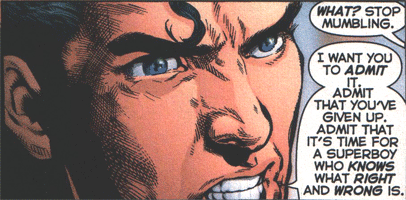
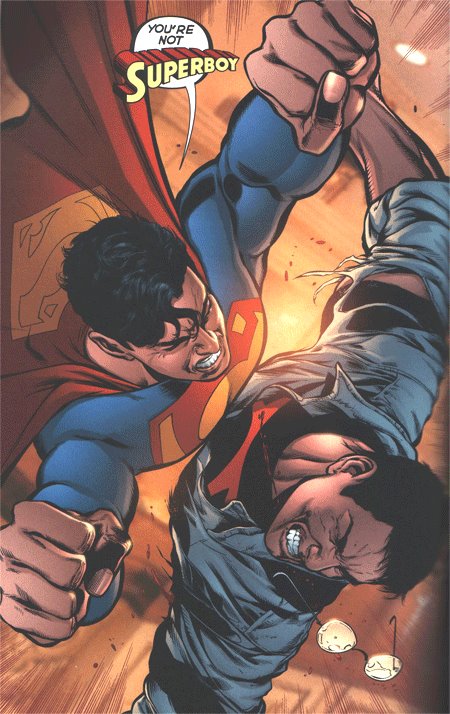
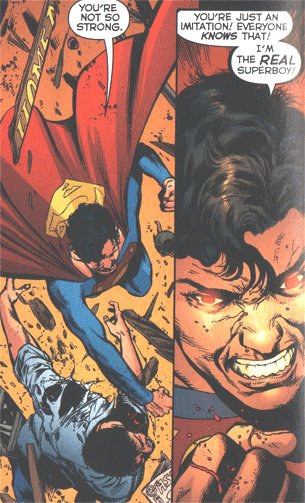
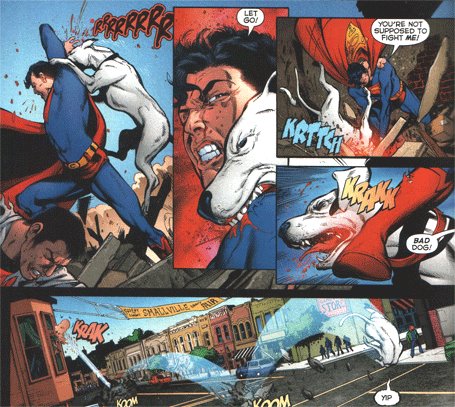
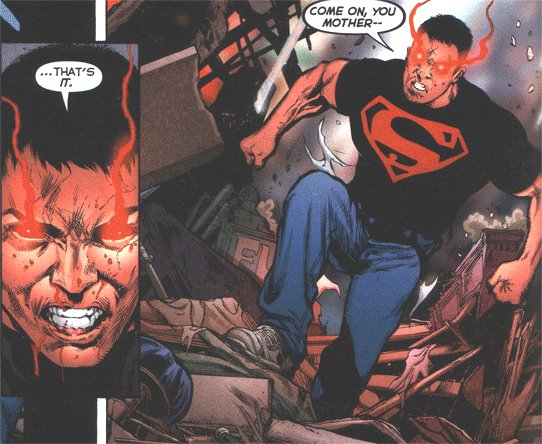
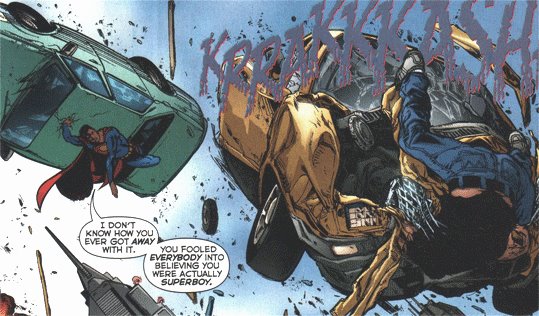
But the main event, taking up over half of the book's length, and the reason that this book ranks on this list, is without a doubt the spectacular fight between the current DCU Superboy, Conner Kent and Superboy of Earth-Prime. Superboy-Prime is a bundle of raw, eternally pubescent nerves who's been huddled away in a heavenly prison for the past twenty years. He watches Conner live the life he never had a chance to, and grows to hate him for his inaction, for his self-doubt.
In a sense, Conner's doubt is a greater reflection on the fact that Superboy-Prime is forever frozen in time: he's never experienced the doubts that Conner has because he is forever young and hopeful, never feeling the heavy weight of responsibility that comes with age.
Superboy-Prime sees in Conner a reflection of his lost future: the cute girlfriend, the cool friends, the supportive family. Face to face with his doppelganger twenty years of pent up, homicidal rage come pouring out.The battle is intense, Jimenez is just great here. He perfectly captures Superboy-Prime's supreme indignation and growing insanity.
Going into this issue I knew nothing about either of the fighters, aside from the basics. I knew that Superboy-Prime was the silver age Superman-to-be; and that Conner came out of the whole Return of Superman mess and used to dress in leather and look like a complete tool. After this issue, and this fight, Superboy-Prime went down as the best villain in the DCU in years, and Conner Kent became somebody that I could really root for.
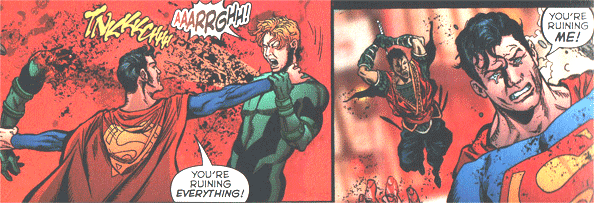
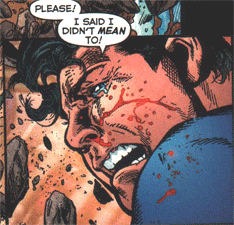
Conner is little match for the pure fury of Superboy-Prime's attack. What do you do against a guy who can fling a taxi at you like it's a Matchbox racer?You call in the Teen Titans, of course.This is where Superboy-Prime loses it forever, when everything truly goes to shit. Cornered and scared, and not understanding the unlimited depths of his powers, Superboy-Prime mows through C and D list Titans, in bloody and horrific fashion.
No, really:The moment is as heartbreaking as it is visceral, as Superboy-Prime pleads for understanding, but can't contain his impulses. He kills at will, tears streaming down his face.Again, I give Jimenez credit for the power of this scene. He creates a chaotic composition that mirrors Superboy-Prime's mental state. He is a little boy lost. He was a hero all his life but now he is beyond saving. What we are witnessing is the tragic origin of the most powerful villain in the DC Universe.
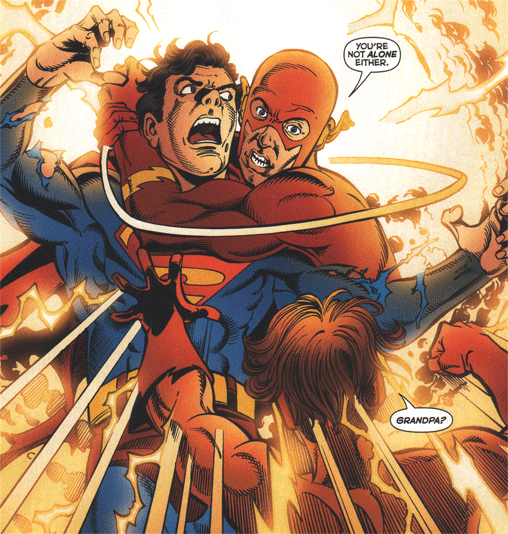
The Titans are bailed out by the Flashes (Jay Garrick the original, Wally West the Post-Crisis Flash, and Bart Allen, current Kid Flash), who come out of nowhere and drag Superboy-Prime along with them at supersonic speed.This is the great moment in Infinite Crisis. The moment that forever links it with its predecessor, Crisis on Infinite Earths. Jay's body gives out on him, and he falls behind. Wally disappears to who knows where (with his family in tow, a cheesy moment that almost stalls the momentum of the scene). Bart is left alone to pull Superboy into the speed zone, with Superboy taunting him all the way. Bart releases his anger and, out of the great shining oblivion beyond comes a hand:It's Barry Allen, the Silver Age Flash, whose death in Crisis on Infinite Earths was one of the all-time great moments in superhero books (creepy just to think about, his face receding until the Flash was nothing more than an empty costume). And, even better, it's George Perez, penciller of the first Crisis, supplying the art. Perez has improved with time. He could always draw a spectacular crowd scene, but this the level of surprise and emotion he brings to this scene is unmatched in his career.
It's the goose-bump moment that Ininite Crisis needed so badly.
With his grandfather's help, Bart pushes Superboy-Prime away into the Speed Zone. As as he fades into nothingness he cries, "When I grow up I'm going to be Superman! Don't any of you understand?! I'm going to be Superma..."
The Silver Age hero that sacrificed himself to save the world has returned to defeat the Silver Age hero that came to destroy it.

I'm a sucker for cross-overs. Well done cross-overs, that is. One of the things I love most about DC Comics is their rich, full Universe, and their ability to shift and play with their characters in ways that are far more meaningful than they're doing down the street at Marvel. Think about it: one of the most beloved icons of the Silver Age has been turned into a raving psycho killer. That takes a measure of guts, because although the kids buying this book don't care about the old Superboy, the collectors who grew up with him do. I hope to see Superboy-Prime stay, he's a great, great villain.
In the end, Infinite Crisis is like a typical summer blockbuster. Loud, corny, and at times obnoxious. But at its heights, it's an absolute blast.

Saturday, April 22, 2006

Top 10 Comics since 1979
9. Daredevil #181: Last Hand


Marvel Comics
April 1982
Writer: Frank Miller
Art: Frank Miller
Finished Art
& Colors: Klaus Janson


Frank Miller, over the course of an almost 30 year career in comics, has been many things: ugly, misogynistic, excessively violent, and sensationalistic.
He is also one the undisputed masters of the form, and holds a complete understanding of comic's strengths and weaknesses. His work envelops you into a world of sight and sound: a total sensory experience. You can hear the voices of his Hell's Kitchen street thugs, you can feel the chill of the night and the steam rising from the street.
His hard-boiled writing style works sometimes and sometimes it falls flat. But, where his characters may lack depth emotionally, he makes up for it through his art that allows you to feel the depth of their suffering.
Last Hand puts a giant-sized, 40 page capper on what may have been the best run of Miller's career: his re-invention of Daredevil. He took one of Marvel's goofiest ideas (a blind superhero. oh-kay...) and made you believe in it. By the time he was done, you had a clear picture of who Matt Murdock was, how his powers functioned, and what was at the seat of his compulsion to stalk the shadows at night.Issue 181 also features a heaping handful of Bullseye, maybe the most underrated, underutilized villains in the Marvel Universe. When the issue starts, he's in Ryker's Island prison, plotting revenge against Daredevil, who put him there. Bullseye is still suffering from his debilitating migraines, and the guards only toy with him, taking their sweet time giving him his medication.Miller turns his pain into a spiky, bright red halo, shooting straight up into the infinity of the panel gutters. This is Bullseye's life: unnerving pain and burning resentment towards the man that not only took away his freedom, but also saved his life.
Three pages later, Bullseye starts his rampage. He breaks out of prison during a live TV interview, and begins his hunt for Daredevil, killing indiscriminately as he goes. Over the course of the book, Bullseye kills at least six people on page, and certainly more off. This is Miller at his best. The fight sequences are kinetic and fascinating, the violence sudden and ugly.
Look at this sequence with Bullseye wondering to himself if Matt Murdock, blind attorney, could actually be Daredevil. It's essentially a splash page, right? Just one picture cut up into a few separate panels.But look at the divides: an empty bottle of booze lies on the floor, a bottle of pills lies spilled, cigarettes burn to their filters untouched. And, running again past the gutters into infinity, Bullseye's echoing, psychotic laughter. With this one page,and with those divisions of time, Miller tells us all we need to know about the character's single minded obsession.

Now, we come to the inevitable. The showdown between Bullseye, Daredevil's greatest enemy and Elektra, assassin for hire and former college lover of Matt Murdock.
Miller can't write women for shit. Elektra is never, at any point during this long arc about her descent from a privileged childhood to a life of vigilante revenge, a well-rounded and defined character. She exists, as so many women do in comics, solely to give the man in her life a stronger motivation for his deeds.
That said: this may be the defining moment in Daredevil's career. This happens right at the right-hand side of the page. When you turn the page, the very next panel, taking up the full left hand side, big as life:That hurts to look at. The same goes for Elektra's last stumbling moments as she makes her way step by agonizing step to Matt's door.Especially chilling: the blood pouring out of her in the first panel, and Bullseye calmly putting on his jacket in the next.

Daredevil and Bullseye meet, finally, in a six-page deathmatch, with Bullseye using Elektra's swords against her former lover. The above panels are among my favorite in the book. Bullseye is so iconic, with his logo well-defined against the black, and I love the frightening, animal ferocity with which he leaps onto the tracks below.
And here is a prime example of Miller's sensory overload:The sound of the train fills up the gutters, becoming an overwhelming roar. You don't need to imagine the sound, it's right there in front of you blocking out all other information, disorienting you just as it does the characters on page.
The climax of the fight comes with the two face to face on a wire high above the city. Miller slows down time, focusing on each second as Daredevil finally gains the upper hand, and again is about to save Bullseye's life.Bullseye would rather fall to his certain death than be in debt to his enemy again. When we see him for the last time he is in the hospital, hooked up to machines and in a full body cast. Even though we can't see it, we can imagine him with an evil grin of satisfaction.
"Maybe I didn't get you this time Daredevil, " he says in the narration, "But I got her, didn't I? I got her good. I wish that hurt you. I wish she's been yours, so that you'd spend long, lonely night staring at the ceiling, thinking about her...but ya can't win 'em all...Meanwhile, there's your buddy Murdock, who helped you beat me. How does he feel?""
Daredevil has won nothing. Bullseye will be out of prison again, Elektra will even rise from the dead. But there is still no victory, the fight simply goes on. Matt Murdock stands at Elektra's grave until he is as still and snow-covered as the tombstones that surround him. As a much better writer than Frank Miller once said:

"His soul swooned slowly as he heard the snow falling faintly through the universe and faintly falling, like the descent of their last end, upon all the living and the dead."

Did I just quote James Joyce in a critical analysis of a Marvel comic? Oh, you bet your ass I did.

Friday, April 21, 2006

Finally, a use for Garfield


I knew something this horrible had to be modern art in disguise. Garfield's true purpose revealed here.


I can't say it's at all surprising that Jon Arbuckle is really a Son of Sam style psychopath.

Seriously: someone needs to do do this every day. This is fucking brilliant.

Wednesday, April 19, 2006

Top 10 Comics since 1979
10. Identity Crisis #5: Father's Day

DC Comics
December 2004
Writer: Brad Meltzer
Penciller: Rags Morales
Inker: Michael Bair


If you ever want to pick a fight at a convention or a comic store, just mention Identity Crisis. Little in recent superhero territory has been as controversial, or as critically acclaimed.
At its most basic level, Identity Crisis is a murder mystery, written by Brad Meltzer, veteran of the genre. Someone is threatening those closest to the DC heroes, which means that someone knows the secret identities of even top tier good guys like Superman; and during the course of the investigation it is revealed that the Justice League has been performing magical lobotomies on C-list villains for decades.
The mystery is a good one, but the story functions best on a basic human level: Superman rushing out the door of the Kent's farm and into the Smallville sky, "Pa, do me a favor and lock the doors."; Ralph Dibny, the Elongated Man, rushing to his wife's smoldering corpse, his arms and face drooped to their limit with grief; the Atom shrinking away into oblivion, destroyed by his wife's betrayal.
Meltzer does first and foremost what any good novelist should do, which is get you deep into the heads of the characters. Green Arrow, political conscience of the JLA, is the pivot point for the big reveals in the book, but Meltzer also breathes life into previously irredeemably goofy characters like the Captain Boomerang and The Calculator.
Rags Morales provides the art, and he's spectacular here. In his theatrical expressions and open layout he's very reminiscent of the great Will Eisner. Also, he has Eisner's sense of using posture as a way to convey character (usually only animators do this well, for some reason comic artists usually don't bother). Without Rags' contributions Identity Crisis would have still been a good read, but with him it's a classic.

Father's Day is the fifth of seven issues. The previous issue ended with Lois Lane receiving a note that read: I know who your husband is, You're Next.
Five opens with the fallout: teams of adrenaline crazed superheroes on a rampage, desperately hunting for information.
Meltzer and Morales create a palpable tension, and a real sense that every hero is at their breaking point. Finally, there is a casualty in the rushing confusion, as Firestorm is pierced by Shining Knight's sword and explodes in the sky above his companions.I have no particular affinity for Firestorm, but the sequence is heartbreaking. Look at the way Morales plays with time in his panels, holding onto those last moments of his flight as Firestorm becomes just a glowing ball over the horizon (Scott McCloud would surely have a thing or two to say about how only the medium of comics could have portrayed this scene in this way, with that kind of lingering impact. Lucky for you, I'm not Scott McCloud).
Then the gorgeous, silent supernova as a hero dies.

The bulk of Issue Five is given over to the story of two sets of fathers and sons. First is Captain Boomerang, Flash's long suffering nemesis, and his son Owen, who he's just recently reunited with. Second, Tim Drake, the current Robin, and his father Jack who has just learned exactly where it is his son goes at nights.
While the Boomerangs gleefully toss their razor tipped and explosive namesakes around in the park; Jack frets endlessly over news coverage of the recent deaths. He is torn by fear and admiration. His son is a hero, a superhero even, and he has at a young age become a man his father has never been. He wants his son safe, but he knows the world is safer with him out fighting for it.
Captain Boomerang is given new life by his son's pride. He's no longer a has-been or a never-was, he's an immediate and terrifying danger.

The horror of this moment is made all the more real by how mundane the set-up is. Jack says goodbye to his son and shuffles into the kitchen, and within moments is crouched on the floor; in one shaky hand a gun, in the other Tim's Teen Titans communicator. Oracle patches the feed into the Batmobile, and it becomes a panicked race against time to get Tim home.
In his fear and vulnerability there is no more Robin, only Tim Drake, tiny and helpless, listening to his father die.
Rags handles this moment perfectly. He shows, for the first time in the book, just how young Tim really is:But, more importantly, the expression on Batman's face when he sees how young Tim is, and remembers not only his own loss, but Dick Grayson's and Jason Todd's. Bruce Wayne, eternally cursed to relive the tragedy that drove him to the shadows. Batman, more than any other hero, wallows in his suffering. He has become his grief and rage. He bears the collective guilt of the DC Universe on his shoulders. He chose to fight crime, but in fighting crime he only ever brought it to his doorstep. That guilt is what Identity Crisis is about. As he drives Tim home, with each moment knowing it's a futile effort, all Bruce can say is, "Not again."The power in the final moments of the book lie in their deafening silence. It's a great comic writer who knows when to trust his artist, and Meltzer lets Rags tell the story. The snarling pride in Captain Boomerang's face as he crashes through the door. The tears streaming down Jack Drake's face as he fires.
The ultimate futility of both men caught in a snare larger than either of them imagined, bleeding their life out together.

Identity Crisis forever changed what was possible in the DCU. For the better or the worse is a matter of opinion. In fact, much of what is being termed as negative about the DCU (and therefore, in need of negation) over in the ongoing Infinite Crisis stems from the brutal drama of Identity Crisis. But the story is about the choices that people make, whether it's putting on a cape or signing divorce papers, and the very real consequences of even the smallest act.

(Hate Idenity Crisis? You're not alone...)

Monday, April 17, 2006

Next time, on GEEK USA...

I am facing that oh-so-dreaded thing in the world of blogging: down time.

LOST is repeats for a few weeks, it's another month until Infinite Crisis' (or is it Crisises?) wrap-up, Seven Soldiers hasn't been heard from in awhile, Marvel's Civil War isn't going yet (and besides, I'm tired of Iron Spidey), and DC's One Year Later books are just...ugh.

So here's what's happening here for the next week or two:

You fellow superhero geeks may have seen the latest issue of Wizard, in which they rank the top 100 single issues in comic books 'since you were born'. Which means approximately 1970 in their eyes.
It has been said that I waste my money in buying Wizard, and I wholeheartedly agree. But I tend to use Wizard as a tool for catching up on books that I'll never pick up. Old characters that while they may be growing tired and poorly used, I still have an affection for (Hulk, Iron Man, Silver Surfer. I used to be a big ol' Marvel Zombie, it's true). Also, during my reentry to the world of the spandex-clad after reading only indies for about ten years, it was a great source for all I'd missed in the 90's (admittedly not much, did you know Batman wasn't Batman for a year and Superman died?).

Anyway, I read Wizard and plan to continue. And, probably because I was out of superheroes for so long, I hadn't read most of the issues they picked. Also, I only go so far with Alan Moore. I think the beard disturbs me. They tend to like him in Wizard world, and a lot of other writers I don't have any particular use for: Warren Ellis, Garth Ennis and others whose names aren't quite so similar.
Another very important problem I had with Wizard's list is that the rules for inclusion stated that the issue had to be a self-contained story. This takes away what, for me, is one of comic's greatest strengths: the forever continuing narrative. There's nothing better than a truly great story arc, and my list contains only one one-shot story.

So here, then is my list of the top 10 comic books since I was born, which in this case is 1979.

1. The Invisibles #23
2. The Dark Knight Returns #1
3. Manhattan Guardian #4
4. Hourman #7
5. We3 #3
6. Chosen #3
7. Animal Man #5
8. Infinite Crisis #4
9. Daredevil #181
10. Identity Crisis #5

Over the next few weeks I'll be discussing (and if neccesary defending) these issues in ascending order, in my usual scan happy fashion. I'd love to get some feedback on my picks, sure, but mostly I want you all to chip in your two cents.
What's your list? What issues get your rocks off? I've shown you mine...you know how it goes.

Ok, thanks for listening. You can go back to surfing porno sites now.

Saturday, April 15, 2006

New Comic Reviews:
JSA and Infinite Crisis Secret Files

JSA #84

I picked up JSA #84 because I'm a huge Rags Morales fan, loved his work on Hourman and Identity Crisis. He's especially strong with expression, maybe because of the huge doe eyes he gives all his characters (in a good guy, it makes them seem more sincere; in bad guys it makes them seem completely bat-shit insane).
Also, I'd read the recent JSA: Classified Infinite Crisis tie-in Power Girl storyline and found the world of the JSA a pretty inviting place: interesting characters, fun villains, a good-time throwback.
But really: what is going on here? I know I walked in on Part Two of this story here, but I don't have any evidence that reading the opening chapter would have aided my understanding of this. I admit I'm not quite as up on the histories of Wildcat or Mr. Terrific as I am the more mainstream members of the DCU, but can any long time readers tell me what is going on here?

We have a LOST-style flashback to the origin of the Gentleman Ghost, and we have him bringing up specters of the JSA's past. This could be all right, but the dialogue is so pedestrian it's painful:
"Back for you in a tic, GL, after I get this Halloween horror locked up!" says the Jay Garrick Flash, who is given a time reference in practically every line. Once is cute, every time is obnoxious.

Rags is one of the most dynamic storytellers in the business, but even he seems stymied by this incomprehensible plot.
Baffling, just baffling.

Side note: since we know Morales uses actors as character references:Drew Barrymore? Am I right, Rags? Do I get a no-prize? Or the DC equivalent?

JSA #84: D+

INFINITE CRISIS: SECRET FILES & ORIGINS 2006

Marv Wolfman was never a spectacular writer, but he has an uncanny ability to take a story overflowing with continuity and make it not only readable, but entertaining. There's a sense of excitement and depth that he brings to this issue that has been lacking from the overall tone of the other Infinite Crisis books. The main reason is that he's telling a full story, spending time with the characters and their motivations instead of just moving them around the chessboard randomly.
We see the sense of longing, and the arrested development, that drives Alex Luthor and, in turn, Superboy-Prime insane. Wolfman turns both our villains into true tragic figures. Alex, robbed of his childhood and locked in a 'heaven' of his own creation outside of time. Superboy, forever haunted by the death of everyone he ever knew; locked in eternal puberty.

There's something more than a little homo-erotic about Alex and Superboy's relationship, as when Alex strips to reveal his Anti-Matter body.What exactly are you 'funneling' into poor little Clark?

Regardless, this is a very good issue. It illustrates that the chief failing of Infinite Crisis is that there's too damn much of it. A self-contained year long event (like the original Crisis on Infinite Earths) would have been more than enough for this sometimes meandering, sometimes wonderful story.
Infinite Crisis Secret Files & Origins 2006: A

Thursday, April 13, 2006

LOST recap: S.O.S.

Mike's back! Say it with me:

WAAAAAAAALLLLLTT!!!

I wonder if poor Harold Perrineau knew that his only contribution to the second season, after being one of the top three or four featured players in season one, would be running through the jungle shouting that exact line; over and over again.
I'm glad to see the Michael-Walt storyline addressed again, because as good as the second season has been it's been painfully obvious that they've written themselves into a pretty big corner here.
The bottom line is: the show has a short timeline, and Malcolm David Kelly will be growing much faster than Walt is. So the writers are faced with the choice of dumping the character or concocting a plot involving time travel or growth experiments that could strain credibility.
I think LOST in general is pretty fearless with their characters, so whatever's happening with Walt, they need to resolve it this season. Hopefully Michael's return is the beginning of that.

Rose and Bernard make me smile. I really, really love these guys, and I was jazzed to see they were getting their very own flashback episode; a nice breather from all the hot angsty flashback action we get with the younger, sexier island residents.

The problem with the episode is that it seemed like they just wanted to get their flashback out of the way, and so they ran through the entire length of their relationship: the meet-cute in the snow, the proposal at Niagara Falls, and the visit to the faith healer to explain their presence on an Australia to Los Angeles flight.
They're good characters, they deserve more than that, the same slow reveals that we've gotten with Sawyer and Locke.

And the visit with the healer was far too similar to Clarie's visit with the psychic in Season One.
There's also the hint that the island itself, and the the big giant magnets or whatever therein, may have healed Rose and Locke.
We also learn that Rose is the only castaway so far to know of John's previously disabled status. The moment with the two of them on the beach was nice (if a bit creepy). L. Scott Caldwell brings a quiet peace to Rose, (which is also needed when certain supposedly level headed 'leader figures' go off screaming in the rain like idiots), but we've seen that side of Rose. The flashbacks were a chance to see different, deeper Rose; and I don't feel like we got that.

We learned a lot here, so why does it feel that we're just like Rose in the snow: spinning our wheels?

In other island happenings; Locke's still throwing a little hissy girl fit about whether or not 'Henry' pushed the button . How about this evil smile:Love that Michael Emerson.
But it's a note too similar to the one Locke's been playing the last few weeks.

We also get Jack and Kate caught in a net together because, well, I guess that's the only way the writers could think to get them that close together. It was a cute moment, if a bit too sitcom-ish. But, for once, Jack actually out-testoseteroned Kate, when he shot the rope.
We also see that Jack still has his Season One crush on Kate, in spite of her stubborn disobeyance in The Hunting Party.

And lonely little Ana Lucia in the hatch: pobresita. She must be pining for the good old days of the Jack and Ana army of two. Maybe if you tried smiling, dear, the boys would pay attention to you.

LOST is all repeats and clip shows until May 3rd, so download the ones you missed kids: we're a-headin' for a showdown.

LOST Episode 2:19; S.O.S.: B-

Saturday, April 08, 2006

New Comic Reviews:
Infinite Crisis and Moon Knight

INFINITE CRISIS #6

Infinite Crisis! Do something already!That'll work.
I guess.
Which Superboy was Conner Kent, anyway? Earth Zero? Earth Fuschia? Planet Starbucks?
Well, no, I guess he was 'ours', and his death, while tragic, gave a much needed shot in the dramatic arm to an entirely lackluster sixth issue.

This one seemed rushed to print. Maybe DC freaked about deadlines after going all of February with no Crisis book, and with all this One Year Later nonsense , and 52 coming right around the bend; it's all about product, people. So Infinite 6 gets a paper thin cover and shoddy art.
It seems like something that (shudder) Marvel Comics would do.
Yeah, I said it.

Infinite 6 begins with this useless exchange:
So it's nice to know that Yankee Stadium has survived the carnage and flooding in New York City, and that Major League Baseball is callous enough to say 'Play Ball' in spite of the death of bazillions (after all, if we don't resume our normal lives after the Infinite Crisis, the OMACS win).
A word to Geoff Johns: quit shoving Ollie and Hal down our throats. We know you like the 70's Adams-O'Neill run, we all did. We get it.

God this issue is just bad all over: cheesy dialogue, and some real ugly art. I think it's Jerry Ordway responsible; though I may be wrong. But just look at this:Ugh! Couldn't they have cleaned that shit up in inking? Ugh!

I think what frustrates me the most about this issue is that there's enough potential there; it just seems like Johns has no idea how to wrap up the series. And One Year Later and 52 just seem like a way to avoid him having to do so.
The reason that something like Crisis on Infinite Earths, or even Identity Crisis, worked was that it was self contained: beginning, middle, and end. Making us slog through back issues of freaking Catwoman to follow lingering story threads is a practice of DC's that's growing old.
I like the interaction between Batman and Brother Eye (a bit too 2001, admittedly); if only because it feels like it's all in Batman's head, that a darker side of himself than he's willing to face wanted this all to happen.
Those scenes feel like the genuinely exciting climax to some old cheesy sci-fi movie you'd run across on TBS at 3 in the morning.
And Superboy Prime continues to be a real kick-ass villain. The mostly Jimenez penciled rematch with him and Conner Kent at the end of the book is really fun.

There are some nice gory moments, like the Spectre disintegrating Star Sapphire:But, who is she again? If Johns had balls, Spectre would have passed judgment on Zatanna for her Indentity Crisis brain tampering. But, being a Seven Soldiers man, I'm glad they didn't. Speaking of the Seven:This makes the only soldier not to make a Crisis guest shot (and Crisis takes place after Seven Soldiers #1, don't forget) The Bulleteer.
A soldier must die, I know, but Alix? Say it ain't so.

I'm not holding a lot of hope now for the wrap-up of Crisis in number 7. Will we actually get to see the great event that takes Superman, Batman, and Wonder Woman away from the world for a year, or will that be revealed in Hawkgirl #whatever?
Wake me when it's over.
Infinite Crisis #6: C-


MOON KNIGHT #1
I'm not really at all familiar with Moon Knight: his world, his powers, his enemies. Which makes his re-launch a perfect place for me to jump in.
Moon Knight #1 does everything that a re-launch should do, it introduces our hero, gives hints of his backstory but also hints of a larger arc of redemption, it paints his world in a specific color (in this case the intense black and grays of the city contrasted with the brilliant white of the hero). Most of all, it's entertaining.

The art is really nice, too. I'm not a big fan, in general, of David Finch's work in New Avengers. Sometimes it comes off as an uneasy compromise between Rob Liefeld and Jim Lee; pinched, tiny faces with rippling abdominals and gigantic breasts.
But here his style works, probably because the general dark atmosphere (and masked hero) feel more authentic than Finch doing the bright red and yellow world of New Avengers.
The only problem, once again: it's too short.
Marvel comics in general, and their top selling titles specifically like New Avengers and Astonishing X-Men, puts out all their stories in a very cinematic style. Few words, lots of action, large splash pages (or pages with only three or four panels to them). It can, when done well (especially by Finch here and X-Men's Cassady) be extraordinary, drawing you deeper into the world on page than you ever could have hoped.
It can also leave you feeling ripped off, getting through a 22-page story in two minutes tops.I'm also not sold on Charlie Huston's writing skills. Yet.
It seems like this issue could have worked well (or even better) as a silent book. The narration really adds nothing to the proceedings, except to tell us that Moon Knight really really likes breaking necks.

And certain aspects of the story, especially the 'Moon 'Copter' and its pilot Frenchie, while probably faithful to the character's history, play more than a bit silly.
If Marvel plays it right, they could finally have their Batman. Handled wrong, just another Spawn.

Moon Knight #1: B

Thursday, April 06, 2006

LOST recap: Dave

Let's just make one thing clear:
This is not all just happening in anyone's mind...
Ok?

Anyway: The knock against Hurley, when anyone dares (or bothers) to knock Hurley, is that he says 'dude' all the time and sounds like a message board (he's still the only character to use the word 'tailies'). Even the episodes featuring Hurley have been primarily comic relief, or just a bit flat (this season's Everybody Hates Hurley). But this one caught me a bit off guard.I was wary coming in, after the roll we'd been on with the Henry Gale storyline the last few weeks; and the decision to switch focus onto a character that hadn't really been doing much of anything this season. The opening with Hurley and Libby ripping up Hurley's stash (Hurley is this season's Charlie, since we actually are seeing him indulge in his addiction) felt off. I do think they're forcing those two together, in spite of whatever mental-hospital-stalker thing Libby has going on:I'm also not sure I like that whole sub-plot, seems like a desperate attempt at making Libby more interesting. And Watros' performance as crazy-Libby reminded me of Jodie Foster in Nell: I'm not sure if she's supposed to be playing it crazy or retarded, and the performance is insulting to either group.

But this episode was funny, very funny in fact. Any episode with the big guy dishing out a well-deserved walloping to Sawyer can't be all bad. And that was hilarious, especially Sawyer trying to crawl out from beneath the tarp, only to be dragged back under (That's for the tree frog, motherfucker!).
What I didn't expect was to be so moved by the moment in the doctor's office, with Hurley talking about the balcony collapse. Probably because his character says 'dude' all the time, and sounds like a message board, I never had Jorge Garcia pegged as one of the better actors on LOST. Turns out he's capable of deep emotion; it was sad and sweet. Loved it.

Back in the hatch, Henry is still just fucking with poor Locke's mind. I pushed the button, I didn't push the button. Good Lord. And John is, as usual, the only one taken in by him.
Now, I'd like to believe the button's nothing. Just a bizarre, sick psychological experiment to drive poor saps like Desmond (where is Desmond, anyway?) and John insane. But if the button really is important, what are Henry's motivations for leading Locke astray?
Besides pure evil, that is.

Next week, Jack gets captured and it's a Bernard and Rose flashback, as if that makes any sense.

LOST Episode 2:18; Dave: B+

Saturday, April 01, 2006

A Day in the Life:
All-Star Superman #3

Maybe it's the LSD or the magic but, for whatever reason, Grant Morrison is a much more openly emotional writer than any of the other 'cool' comic writers. The problem with 'cool' is that it so often falls into the trap of mean, of overwhelming irony and sarcasm. 'Cool' in comics all too often means bloody, means constant cursing, means whiny petulant slacker diaries.
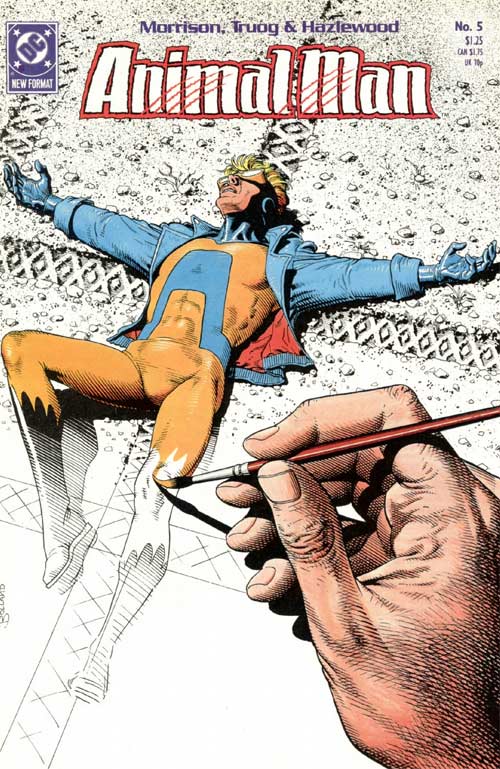
Instead of running from emotion, Grant uses it to his advantage, creating fuller characters and more genuine, thrilling moments. In Animal Man's finale, he wrote himself into the story, apologizing to his character for the turmoil in his life, and gave Buddy Baker back his family. Like any decent creator, divine or otherwise, would.
In Manhattan Guardian #4 he raised the emotional stakes to 11, with Jake Jordan on the edge of something beyond his understanding and grateful just to not be alone in facing it.
All-Star Superman is a throw back to the Silver Age of comics. A time that, while undeniably goofy, was fun and sweet. In embracing the spirit of the Silver Age, Grant and his partner Frank Quitely have finally given us (after over 60 years of trying) a Superman that works.

Issue 3, in fact, presents us with a familiar Silver Age scenario: Lois Lane is given Superman's powers for 24 hours.
Superman's powers are so familiar to us that we take them for granted, but through Lois' eyes we see them anew. As she says after her powers wear off, "...I can't smell the trees in Canada. I can't see all that gorgeous radio anymore...the stars have stopped singing like they used to."
Where Superman yawns at nuisances like Krull of the Subterranosauri ("MEH-TRUH-PUH-LIISZZ! KRULL WILL EAT YOU!"); Lois charges into battle.
"I'd have felt cheated if there hadn't been monsters."


"Everybody can see what Lois Lane sees in you, but...y'know, why me, Superman?"
Superman kind of dodges that question in the book, but he doesn't need to answer. We see why Superman and the super-powered fools Atlas and Samson are fighting like eight-year-olds on the playground for her.Grant and Frank's Lois is defined by strength, inside and out. This is not some pushy girl-reporter trying to prove herself to a room full of men; this is a supremely confident and intelligent woman.
Quitely (or Vince as his mother calls him) shows this, and much more, through facial expression and posture. He really is the best artist working in comics today, All-Star Superman could function without words. For instance, we know that Lois is only trying to make Superman jealous with the dueling strongmen: she's flirty whenever Superman's watching, bored with their antics when he's not.
I'm also beginning to think that Quitely is using Elvis Presley as a reference for Superman:Do you see it?
Anyway, dead rock stars aside, this Superman is one thing above all: humane. He acts out of love and compassion, not just for Lois, but for the whole world.
Since we are given a fresh sense of his powers through Lois' experience, we can understand what it must be like to live in constant awareness of your surroundings. Remember, now, from issue one where Clark Kent runs into a man on the street, saving him from being hit by falling debris from a car wreck.
Superman is at all times decent and caring. He helps people, he saves the world again and again, because it is the right thing to do.
(A very Silver Age concept. Truth, Justice, and the American Way never had the same ring after Watergate.)
He helps people because it's what people should do. Basically all the best parts of the Sermon on the Mount.
In All-Star Superman, we also know that Superman is dying. In issue 1 he absorbed too much solar radiation, which only he and the time traveling Samson know in issue 3.
In this issue, Superman descends into the Underworld like Orpheus, but his faith in Lois, and her faith in him, save her from oblivion. Lois' experience on the border of life and death further links her to the dying Superman.
In giving Lois his powers for a day, he showing her what it was like to be him. To share with her the all-encompassing love of the world that only he can feel.
All-Star Superman #3: A+

New Comic Reviews:
Green Lantern and Ex Machina

GREEN LANTERN #10

You're right, Hal. I shouldn't have bothered.
I had high hopes for this series, since I liked Geoff John's writing on Green Lantern:Rebirth. He seemed to have a pretty good handle on Hal Jordan; and I really liked Ivan Reis' work on Rann-Thanagar War (until the farmed-out jumble of the last few issues).
So I was very dissapointed to find Green Lantern #10 a confusing, artistically dreadful bore.

This is the only of the 'One Year Later' series of books I've bothered to read so far. In effort to maintain fan excitement in their universe's struggles, DC is wearing itself way too thin.
First we had several months of a 'countdown' to Infinite Crisis, then we've had the Crisis itself, now the whole of the DC Universe is jumping forward a whole year which will play out in book form after Crisis is over (still another few months away!) in a weekly series, 52.
The Countdown books were, overall, entertaining, and Crisis itself (see below) has been good. The idea of jumping straight into a whole new world, and slowly revealing what happened during that missing year is a good one (but didn't Marvel do that 20 years ago with Secret Wars?).
This is just a bad book.

It seems like Reis, who was working on his own style, has back pedaled into a bad Neal Adams impersonation.His composition is clunky; it's an ugly book.
Where does the fault lie? Is his work rushed? Or is he poorly inked?Marc Campos worked with Reis on Rann-Thanagar, and did a solid job.
For reference, here's a few panels from Rann-Thanagar:
Love that.
But they're shit here.
And Johns' story doesn't capture us in a way that could make up for the lousy art.
We see a womanizing, somewhat brooding Hal; a whiny Ollie; and cookie cutter Top-Gun reject pilots.
Oh, and we end with this:Ugh. You can stick around for the cliff-hanger. I'm outta here...

Green Lantern #10: F

EX MACHINA #18

This issue seemed too much like a place holder. It's not bad, but it proceeds the storyline ahead in a way that's a bit too predictable.
Typical war room scene, typical bedside hospital scene, typical roving gangs of new york lynching arabs scene.
The dialogue was way too cute. Yet another 'Journal was my intern but I swear I never fucked her' joke (one is ok, but we should be past that). Mayor Hundred, in the same scene, quotes the first Superman movie and it plays ridiculous, not heartbreaking. And the exchange between the aforementioned Punks and Arabs:
Nitpicking, maybe, but all of these moments threw me out of the story (which is a good one).
I liked a few things, especially Commissioner Angliotti's harangue of the the FBI:I still like where the story arc is going, but overall, there just wasn't enough here.

Ex Machina #18: B-